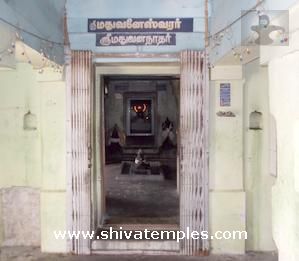
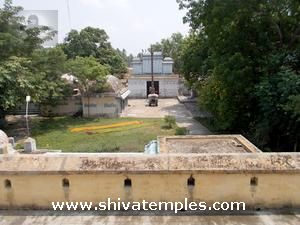
Madhuvaneswarar temple, Nannilam
Location
Nannilam
Deity
MadhuVaneswarar, Brahadeeswarar
Female Deity
Madhuvana Nayaki, Brahadeeswari
Pathikam
Sundarar - 1
Gallery – Madhuvaneswarar Temple, Nannilam

How to Reach
This Shiva temple is situated in Nannilam, approximately 17 km from Tiruvarur and about 30 km from Kumbakonam. Nannilam lies on the Kumbakonam–Nagore road and can also be conveniently reached from Mayiladuthurai. From the Nannilam Bus Stand, proceed towards Tiruvarur and take the road opposite the Government Hospital to reach the temple.
Temple Address
Nannilam
Nannilam Taluk
Tiruvarur District
PIN – 610105
Temple Hours
Morning : 7:00 AM - 12:30 PM
Evening : 4:00 PM - 8:00 PM
Nearby Paadal Petra Shiva Temples
Temple History
A Maadakovil Built by Kochengat Chola
King Kochengat Chola, remembering the hardships he had endured in a previous birth due to an elephant, built seventy elevated temples known as Maadakovils, designed in such a way that elephants could not enter them. The Madhuvaneswarar Temple at Nannilam is one such sacred Maadakovil. Sundarar, in his Thevaram hymns, glorified this temple as a Perunkovil (great temple) and, in the concluding verse of his pathigam, specifically mentions that the temple was built by Kochengat Chola.
The Origin of the Name Madhuvaneswarar
During the Dvapara Yuga, an asura named Vrithrasura tormented the Devas and caused great suffering. Seeking refuge, the Devas prayed to Shiva for protection. To shield them from the asura, Shiva transformed the Devas into honeybees and instructed them to dwell within the sanctum and worship the Shiva Lingam. Since the Devas worshipped the deity in the form of bees, the presiding deity came to be known as Madhuvaneswarar, while the Goddess became known as Madhuvana Nayaki. The place itself acquired the name Madhuvanam, meaning "the grove of bees." Even today, honeybees can be found living peacefully within the sanctum and in secluded spaces around the temple without causing harm to the visitors.
Adisesha and Vayu
Temple legend recounts a contest between Adisesha, the celestial serpent, and Vayu, the god of wind, over who possessed the greater strength. To demonstrate his power, Adisesha tightly coiled himself around Mount Kailasa with his thousand hoods, while Vayu assumed the form of a mighty storm and attempted to dislodge the mountain with powerful winds. Despite his efforts, Vayu could not move the mountain while Adisesha held it firmly. Concerned by the intensity of their rivalry, the Devas intervened and requested Adisesha to relax his grip. As soon as he did so, Vayu succeeded in dislodging a peak from the great Mount Meru and carried it southward. According to the temple's Sthala Purana, a small fragment of that peak fell at this sacred site. The area, which had previously been flat land, was transformed into a small hillock, upon which the temple was subsequently built.
Temple Structure
Rajagopuram
Situated on the southern bank of the Mudikondan River, this ancient temple complex extends approximately 270 feet in length and 135 feet in width. The temple's Rajagopuram (main entrance tower) is a two-tiered structure that leads devotees into the outer prakaram. Directly opposite the entrance is the sannidhi of Brahmapureeswarar, worshipped by Brahma, while nearby stands the sannidhi of Agastheeswarar, worshipped by Sage Agastya. As one circumambulates the outer prakaram, separate sannidhis dedicated to Siddhi Vinayaka, Subramanya, Mahalakshmi, Chandikeswarar, Saneeswarar, Bhairavar, Surya, and the Navagrahas can be seen. The sannidhi of Goddess Durga of Nannilam is especially revered for her divine power and grace.
Main Sanctum
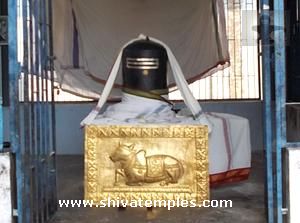
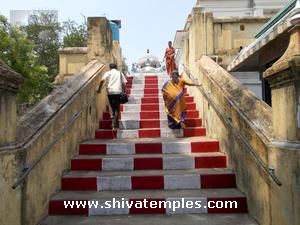
The sanctum of the presiding deity is situated atop an artificial hillock (Kattumalai), which devotees reach by ascending a flight of steps. The prakaram on the hill houses a beautiful sannidhi for Somaskandar. Madhuvaneswarar, the presiding deity, manifests as a self-existent (Swayambhu) Shiva Lingam with a slightly elevated cylindrical form set upon a square-shaped Avudaiyar. The sanctum faces east. During special occasions, the deity is adorned with a sacred lily decoration and the Nagabharanam (serpent ornament). The Goshta deities adorning the sanctum walls include Vinayaka, Dakshinamurthy, Lingodbhava, Brahma, and Durga.
Unique Features
Several distinctive features make this temple unique. Bhairavar is enshrined near Surya, while all the Navagrahas face Surya. Surya and Guru (Jupiter) are positioned facing each other, and Saneeswara has a separate sannidhi of his own. Chitragupta is also worshipped in an independent sanctum. The temple's sacred tradition further records that Yama established and worshipped a Shiva Lingam in the south, Varuna in the west, Indra in the east, and Kubera in the north. Indra and other Devas, Surya, and King Bruhathraja are believed to have worshipped Madhuvaneswarar at Nannilam.
Sacred Theerthams
According to temple tradition, King Bruhath prayed to God Shiva for a water source at this site. In response to the king's request, Shiva created a tank to the north of the temple by striking the ground with His trident and then filled it with the waters of the sacred Ganga flowing from His matted locks. This tank is revered by several names, including Soola Theertham, Bruhat Theertham, and Madhu Theertham.
Another sacred water body associated with this temple is the Chakra Kulam. Temple legend states that when Shiva destroyed the asura Jalandhara, the divine discus that was used in the battle fell near this site. The spot where it landed became a holy tank, which is now known as Chakra Kulam. This sacred theertham is situated a short distance to the east of the temple.
More Gallery – Madhuvaneswarar Temple, Nannilam