Kutralaanathar Temple, Kuttralam
Location
Kuttralam
Deity
Kuttralanathar, Kurumpalanathar, Trikootanathar, Trikootachaleshwarar
Female Deity
Venu-VakVathini, Kuzhalvoi Mozhiammai
Pathikam
Sambandhar - 2
Gallery - Kutralaanathar Temple
How to Reach
This Shiva Temple is located about 5 kilometers from Tenkasi. Tenkasi is well connected by both road and rail from Madurai and Tirunelveli. Regular bus services are available from Tenkasi to Kutralam. Train numbers 16101 and 12661 from Chennai Egmore, and train number 20683 from Tambaram, operate services to Senkottai, which is about 7 kilometers from Kutralam.
Temple Address
Courtallam Post
Tirunelveli District
PIN – 627802
Temple Hours
Morning : 6:00 - 12:00
Evening : 4:30 - 8:00
Salient Features
- Shakthi Peetam: This temple is Parashakthi Peetam and is revered as one of the sacred Shakti Peetam.
- Pancha Sabha: This temple is one of the five Pancha Sabha temples dedicated to Nataraja, representing the Chitra Sabha.
- Swayambhu Linga: The presiding deity is a self-manifested (Swayambhu) Linga that is believed to have transformed from an idol of MahaVishnu.
- Unique Legend: This is the temple where Sage Agasthya is believed to have witnessed the celestial wedding of Shiva and Parvathi.
- Conch-shaped Temple: The temple layout is designed in the shape of a conch, reflecting its Vaishnavite origins.
Temple Legend - Sage Agasthya's Journey
During the celestial wedding of Shiva and Parvati at Mount Kailash, the presence of countless gods and sages gathered in the north caused the earth to tilt slightly. To restore balance, Shiva asked the revered sage Agastya to travel to the southern regions. Agastya felt sorrowful at leaving, as he wished to witness the divine marriage. Understanding the sage’s devotion, Shiva granted him a boon that he would be able to behold the sacred wedding from wherever he was and whenever he desired.
Places visited by Sage Agasthya in his journey to south -
- Tiru-Kodunkundram
- Kutralam
- Tiru-Panankattur
- Tiru-Kallil
- Tiru-Votriyur
- Tiru-Verkaadu
- Tiru-Vaanmiyur
- Achirupakkam.
- Tiru-Nallur
- Tiru-Nani-Palli
- Tiru-Aakkur
Upon reaching the Podhigai Hills, Sage Agasthya bathed in a nearby waterfall and proceeded to the temple. As a staunch follower of Shaivism, he was denied entry, since the temple was then dedicated to Mahavishnu. Deeply distressed by this turn of events, the Sage travelled to Ilanji, where he prayed earnestly to Muruga.
The Divine Transformation
Muruga advised Sage Agasthya to disguise himself as a Vaishnava in order to gain entry into the temple, where he would be blessed to witness the divine wedding of Shiva and Parvathi. Following this counsel, the Sage entered the temple in disguise and beheld the deity Mahavishnu in the sanctum. He then prayed earnestly, closed his eyes, and placed his hand upon the idol of Mahavishnu.
The Miraculous Event
According to temple tradition, a miraculous event occurred when the idol began to shrink and ultimately transformed into a Shiva Linga. At that very moment, Sage Agasthya was granted the divine vision of the celestial wedding of Shiva and Goddess Parvathi—a sacred spectacle he had been unable to witness in person due to his journey to the south. The Shiva Linga that emerged from this transformation is believed to bear the imprint of the sage’s palm, left behind when he reverentially pressed it in devotion. The legend further states that, just as the image of Mahavishnu transformed into a Linga, Sridevi manifested as Kuzhalvaimozhi Ammai, while Bhudevi assumed the form of Parashakti, highlighting the profound unity of the divine forms worshipped at this sacred site.
Temple Layout and Architecture
Main Sanctum
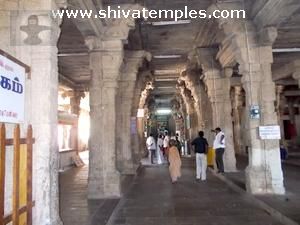
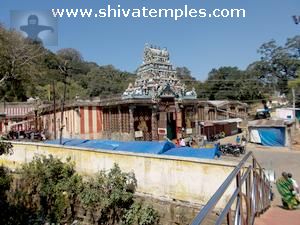
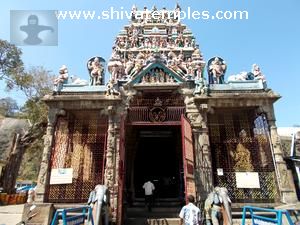
Nestled at the foothills of the picturesque Trikutamalai, which rises to an elevation of approximately 5,000 feet, this temple enjoys a stunning natural setting. The temple complex extends over an area of nearly 3.5 acres and features four entrances, providing access from different directions. A distinctive architectural feature of the temple is its conch-shaped layout, a unique design that reflects its ancient association with Mahavishnu before it became a prominent Shaivite temple. The presiding deity, Trikootanathar—also known as Kutralanathar—is worshipped in the form of a self-manifested (Swayambhu) transformed Linga, facing east. The sannidhi of Kuzhalvaimozhiyammai is located to the right of the presiding deity’s sannidhi and also faces east.
Bird's Eye View
The conch-shaped layout of the temple can be clearly seen from a bird’s-eye view near the waterfall, along the path leading to the Senbhadevi Temple on the hill.
Parashakti Peetam
The Kutralanathar Temple is revered as one of the 'Shakti Peetam' temples. This sacred Parashakti Peetam, consecrated by Sage Agasthya, is located in the prakaram surrounding the sanctum.
Prakaram & Sannidhis
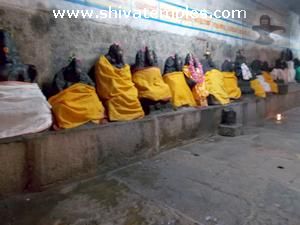
Along the path of the prakaram, we can see sannidhis of:
- Adhikhara Nandi
- Surya
- Kumbhamuni
- Panchaboothalingam
- Nannakaraperumal
- Subramaniya
- Saneeswara
- Goshta Murthas: Dakshinamurthy, Vinayaka and Sapthamatha
Pancha Sabha Sthalam - Chitra Sabha
Kutralanathar Temple is one of the revered Pancha Sabha temples associated with Nataraja. About one kilometre from the main temple stands the Chitra Sabha, a separate and architecturally significant structure situated beside a small pond. Renowned for its exquisite wooden carvings, the sabha showcases remarkable craftsmanship, while its roof bears a striking resemblance to that of the famous Chidambaram Temple. The structure comprises two halls: the first is designed with numerous windows that allow abundant natural light to illuminate the interior and serves as the venue where Nataraja is ceremonially placed on a central platform during the Tiruvathirai festival. The second hall is celebrated for its captivating murals depicting all sixty-four Tiruvilayadals, the divine exploits of Shiva, rendered in vibrant colours and intricate detail. The Chitra Sabha faces east, while the idol of Nataraja enshrined within is oriented towards the south, in keeping with the temple’s sacred traditions.
Gallery - Kutralaanathar Temple